Play Chords, Scales and Intervals
Scale
A scale is a set of notes or pitches that are arranged in a particular order. When you mention the note names C D E F G A B C, you have mentioned the C Major Scale.
Chord
A chord is a set of notes chosen from a specific scale. When you choose every other note from the C Major scale, you will get the C chord C-E-G.
Interval
A tonal distance between two notes is called an interval. A semitone is the smallest interval. In guitar one fret equals one semitone. One whole tone is equivalent to two semitones or two frets.
Major Scale Pattern
In the C Major Scale the semitones fall between E and F and between B and C. The semitone interval is between the 3rd and 4th notes and the 7th and 8th notes. All other intervals are whole tones. This pattern is valid for all major scales, and we can express the generic major scale with numbers which represent intervals or Scale Degrees. The 4th and 8th scale degrees in the major scale are flat, or decreased by a semitone, and are denoted by the symbol ♭. Note also that there are two 'tone-tone-semitone' patterns, separated by one tone. The degree one is called a root. Then comes 2nd, 3rd, 4th...
| C | D | E | F | G | A | B | C |
| 1 | 2 | 3 | 4 | 5 | 6 | 7 | 8 |
| tone | tone | semi | tone | tone | tone | semi | |
| 1 | 2 | 3 | b4 | 5 | 6 | 7 | b8 |

| C | D | E | F | G | A | B | C |
C Major Chord
- The root note of C Major Scale is on the 5th string 3rd fret.
- The 3rd note E is on the next string one fret to the left. This is the major third interval, also known as the 3rd.
- The 5th note G and interval is one string higher and two frets to the right from the root note.
- You can use this pattern to find the root chord of any major scale by simply looking at the fretboard of your guitar. Find the root note from strings 6 to 4. The 3rd is one fret to the left, the 5th is 2 frets to the right on the next string. This works as long as you do not go to 2nd string.
- The rule aids in determining which notes make up a given major chord.
- The fingering pattern may be different but the rule helps you to find the right notes and to get familiar with the fretboard.
C Major Scale in III Position
- The 4th, F note, is one string higher in the same fret position as the root, C.
- The 6th, A note, is one string higher in the same fret position as the 3rd, E.
- The 8th, C note, is two strings two frets higher than the root, C.
- If you have a note on 6th or 5th string, the same note an octave higher is always two strings and two frets higher.
Universal Rule for Major 3rd and 5th
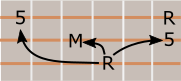
R stands for Root.
M stands for Major 3rd.
5 stands for 5th degree.
Now you know the notes up to the 5th fret. Play the C Major Scale from low to high and vice versa. Try also alternate plucking, on strings 6-4 alternate your thumb and index finger, and on strings 3-1 alternate your index and middle (and ring) fingers.
Guitar Chord Finder
Choose the chord base name first, followed by any extra qualifiers, and the chord finder will display the chord. Also the scale and the position of the chord in the CAGED system are displayed. You can move along the fretboard with the left and right arrow buttons. Fingering of the chord is displayed as default. You can choose the notes of the chord or the scale degrees of the chord notes to be displayed by checking the proper checkbox.
Melodic Minor Scale
The ascending melodic minor scale lowers the degree 3 of the major scale.
| 1 | 2 | b3 | b4 | 5 | 6 | 7 | b8 |
The descending melodic minor scale is identical to the natural minor scale.
Harmonic Minor Scale
The harmonic minor scale lowers the third and sixth tones of the major scale.
| 1 | 2 | b3 | b4 | 5 | b6 | 7 | b8 |
There are three semitones between 6th and 7th degrees.
Natural Minor Scale
The natural minor scale lowers the degrees 3, 6 and 7 of the major scale. With the help of the pattern illustrated below, it is simple to create any natural minor scale.
| 1 | 2 | b3 | b4 | 5 | b6 | b7 | b8 |
| Example 1: The natural C minor scale | |||||||
| C | D | Eb | F | G | Ab | Bb | C |
| Example 2: The natural A minor scale | |||||||
| A | B | C | D | E | F | G | A |
The natural A minor scale has no accidentals, and it is the relative minor of C major scale. The relative minor scale starts on the sixth tone of its relative major scale, or a minor third (three half steps) below the relative major. Every major scale has a relative minor scale and the other way around.